

All iLive content is medically reviewed or fact checked to ensure as much factual accuracy as possible.
We have strict sourcing guidelines and only link to reputable media sites, academic research institutions and, whenever possible, medically peer reviewed studies. Note that the numbers in parentheses ([1], [2], etc.) are clickable links to these studies.
If you feel that any of our content is inaccurate, out-of-date, or otherwise questionable, please select it and press Ctrl + Enter.
Diprospan for gout: does the injection help, when is it prescribed, and what are the risks?
Medical expert of the article

Last updated: 30.03.2026
Diprospan can be used for gout, but its role in treatment is narrow and very specific. It is not a drug that eliminates the cause of the disease. Its purpose is to quickly suppress inflammation during an acute attack, when the joint is sharply painful, red, and swollen, and the person cannot walk or move the limb normally. Current recommendations include glucocorticosteroids among the primary agents for relieving a gout attack, along with colchicine and nonsteroidal anti-inflammatory drugs. [1]
Two factors are particularly important for Diprospan. First, the decision to use it is usually made when colchicine or nonsteroidal anti-inflammatory drugs are contraindicated, poorly tolerated, or have failed to produce the desired effect. Second, the route of administration is important. For gout, the physician may consider intramuscular administration as a systemic option or intra-articular administration as a local option if one joint is affected and the diagnosis is certain. [2]
Below is a detailed analysis of when Diprospan is truly appropriate for gout, its limitations, why the disease can still return after a successful injection, and what actually changes the long-term prognosis.
The main thing you need to know about Diprospan for gout
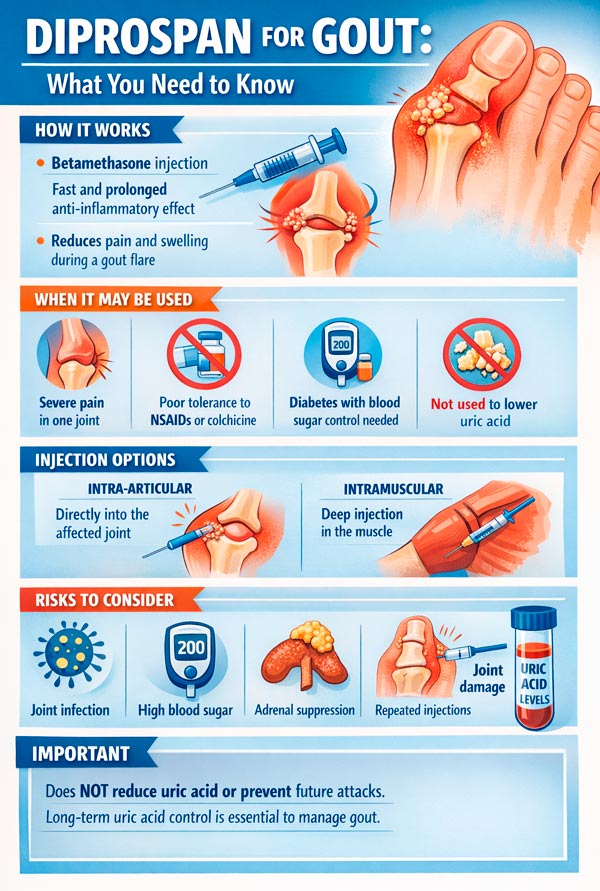
Diprospan is an injectable betamethasone preparation. Available registration documents describe it as a suspension containing two betamethasone esters: a soluble part that acts more quickly, and a less soluble part that produces a longer-lasting effect. This is why the drug is often perceived as a "fast and long-acting" anti-inflammatory injection. [3]
From a clinical guidelines perspective, its rationale is simple: it is one option for relieving an acute attack of gout. The American College of Rheumatology explicitly classifies glucocorticosteroids, including oral, intra-articular, and intramuscular, as first-line treatments for an attack. The UK National Institute for Health and Care Excellence guidelines also allow for intra-articular or intramuscular corticosteroid administration if colchicine and non-steroidal anti-inflammatory drugs are unsuitable. [4]
The key distinction is crucial: Diprospan suppresses the inflammatory response, but does not remove monosodium urate crystals or reduce their tissue deposits. Gout progresses because elevated uric acid levels lead to the formation of new crystals, and long-term therapy is needed specifically to dissolve them and prevent further attacks. Therefore, a successful injection and disease control are not the same thing. [5]
In practice, Diprospan is most often discussed in two scenarios. The first is a very painful acute attack, when rapid anti-inflammatory action is needed. The second is a patient with comorbidities, for which standard options are limited. For acute monoarthritis, intra-articular corticosteroid injection can be particularly beneficial, and for multiple joint lesions, systemic administration is sometimes chosen. [6]
It's also important to keep in mind that regulatory status varies by country. Some registrations explicitly list acute gouty arthritis among the indications for betamethasone injections, while the British guideline specifically lists injectable corticosteroids for gout attacks as off-label use. This doesn't make the treatment "bad," but it does explain why medical practices and instructional wording may differ across countries. [7]
| What is important | Practical meaning |
|---|---|
| Diprospan does not treat the cause of gout. | It relieves inflammation during an attack. |
| This is a first-line option as a class of drugs | But it is not the only one and not mandatory for every patient. |
| The choice depends on concomitant diseases | Especially from the tolerance of colchicine and non-steroidal anti-inflammatory drugs |
| Local administration is useful for 1 inflamed joint | But only after assessing the risk of infection |
| After the injection, a long-term monitoring plan is still needed. | Otherwise, the attacks may recur. |
Source for the table: [8]
In what situations would a doctor even consider injectable betamethasone?
Modern guidelines recommend choosing a treatment for an attack not based on a "template," but rather taking into account concomitant illnesses, existing medications, and the patient's preferences. This means that Diprospan is not an automatic choice for every person with gout. It is usually considered when the physician has reasons not to use colchicine or nonsteroidal anti-inflammatory drugs, or when an alternative route of administration is needed. [9]
A topical corticosteroid is especially useful for inflammation of one large or medium-sized joint. British Rheumatology Guidelines emphasize that joint aspiration and corticosteroid injection can be very effective in acute monoarticular attacks and are often the preferred option in patients with comorbidities. This is important for the knee, ankle, elbow, wrist, and some joints of the foot. [10]
In diabetes mellitus, the decision becomes especially cautious. A recent review of the treatment of gout attacks notes that oral glucocorticosteroids are well known for their ability to increase blood glucose levels, so intra-articular administration may be preferred, if possible, to reduce systemic effects. The registration information for Diprospan also specifically states that betamethasone should be used for short periods of time and under close medical supervision in patients with diabetes. [11]
There is also a reverse situation, when rushing an injection is unavoidable. If the diagnosis is unclear, septic arthritis and other causes of acute red joints must first be ruled out. The National Institute for Health and Care Excellence recommends, in case of doubtful diagnosis, joint aspiration with synovial fluid microscopy, and if this is not possible, imaging, including ultrasound or dual-energy computed tomography. Intra-articular corticosteroids are dangerous if infection is suspected. [12]
Data for severely ill hospitalized patients are also interesting. In a 2022 randomized trial, a single intramuscular injection of betamethasone in hospitalized patients with an acute attack showed good pain reduction and acceptable safety, with no significant differences in analgesic effect compared to adrenocorticotropic hormone. This does not mean that Diprospan should become a universal standard, but it confirms that betamethasone is a viable option in complex clinical settings. [13]
| Situation | When can Diprospan be discussed? |
|---|---|
| Acute attack with severe inflammation | Yes, as one of the options for docking |
| 1 affected joint | Local administration is often preferred. |
| Poor tolerance of colchicine | Considered as an alternative |
| Restrictions for nonsteroidal anti-inflammatory drugs | It might be useful |
| Diabetes mellitus | Possible, but with caution and glucose monitoring |
| Suspected joint infection | No, septic arthritis is ruled out first. |
Source for the table: [14]
How the drug works and how it is administered
The pharmacological logic of Diprospan is linked to its composition. The soluble fraction of betamethasone begins to work more quickly after administration, while the poorly soluble fraction creates a depot and maintains the effect longer. This combination explains why relief can occur quickly after injection and then last longer than with a very short-acting corticosteroid. [15]
The instructions emphasize that the dosage is always individualized based on the severity of the disease and clinical response. For systemic use, the drug is administered deep intramuscularly, while for local action, intra-articular and periarticular administration are possible. This is an important point: the same drug can be used as a systemic or local agent, but the clinical objectives are different. [16]
For intra-articular use, the registration information provides volume guidelines based on joint size: large joints - 1-2 milliliters, medium joints - 0.5-1 milliliter, small joints - 0.25-0.5 milliliters. It is specifically noted that for certain foot conditions, including acute gouty arthritis, volumes of 0.5-1 milliliter may be used. These figures are not suitable for independent dosage selection, but they help to understand that the drug is used very differently depending on the anatomical area. [17]
An important practical conclusion is that local administration and intramuscular injection are not interchangeable. If a single joint is inflamed, the physician is often more interested in targeting the lesion rather than imposing a systemic burden on the entire body. However, if multiple joints are affected or local administration is technically impossible, the logic may shift toward the systemic route. Therefore, a good result depends not only on the drug itself but also on the correct choice of administration route. [18]
There are also strict technical restrictions. The registration documents for betamethasone injections explicitly state that the drug cannot be administered intravenously, subcutaneously, or epidurally; strict aseptic technique is mandatory for intra-articular administration. For the patient, this means a simple rule: Diprospan for gout is not a "home injection," but a procedure in which an error in the route of administration or a breach of sterility can result in serious problems. [19]
| Route of administration | Why is it used? | What is important to remember |
|---|---|---|
| Deep intramuscular injection | Systemic suppression of inflammation | It is not suitable for everyone, it gives a more general effect |
| Intra-articular administration | Local treatment of 1 joint | A confident diagnosis and sterile technique are needed. |
| Periarticular administration | For periarticular inflammation according to indications | The decision depends on the anatomy and experience of the doctor. |
| Intravenous, subcutaneous, epidural administration | Not used | These are prohibited routes for the drug. |
Source for the table: [20]
Security and errors that are dangerous
Any injectable glucocorticosteroid has situations where the risk becomes excessive. Contraindications for betamethasone suspensions include hypersensitivity to the drug and systemic fungal infections. The registration documents also specifically state that intramuscular administration is contraindicated in cases of idiopathic thrombocytopenic purpura. [21]
A separate set of risks is associated with infections. Corticosteroids suppress the immune response and can mask signs of infection, making it particularly dangerous to inject the drug into a joint if septic arthritis is actually present. Official information on betamethasone injections also notes the risks of reactivation of tuberculosis, hepatitis B, and worsening of systemic fungal infections with immunosuppressant use. [22]
For people with diabetes, the main concern is hyperglycemia. A recent review of the treatment of gout attacks emphasizes that systemic glucocorticosteroids can significantly increase blood sugar levels, so local intra-articular administration is preferable in appropriate clinical settings. In a study of hospitalized patients, metabolic changes with betamethasone were generally minimal and transient, but this does not eliminate the need for monitoring in vulnerable patients. [23]
There are also local complications. The registration information lists post-injection exacerbation after intra-articular use, the risk of joint contamination, subcutaneous and cutaneous atrophy, and, with repeated intra-articular injections, the possibility of joint damage. This is an important reminder: a series of "rescue" injections without a clear plan is not harmless, even when each individual injection appears effective. [24]
With prolonged or repeated use, a systemic problem arises—suppression of the body's own adrenal function. The instructions for Diprospan indicate that abrupt discontinuation after prolonged or high-dose therapy can lead to adrenal insufficiency, and in a comparative study with adrenocorticotropic hormone, betamethasone had a stronger effect on the hypothalamic-pituitary-adrenal axis and bone metabolism. For the patient, the conclusion is simple: the more often the thought of "having another injection" arises, the more important it is to return to a basic uric acid control strategy. [25]
| Risk | Why is this important for gout? |
|---|---|
| Latent infection | Corticosteroids may mask septic arthritis |
| Increased blood glucose | Especially relevant for diabetes |
| Joint damage with repeated injections | The risk increases with frequent intra-articular use. |
| Adrenal suppression | More important for repeated and longer courses |
| Systemic infections, tuberculosis, hepatitis B | Require special risk assessment |
| Route of administration error | Intravenous and epidural routes for the drug are unacceptable. |
Source for the table: [26]
Why can gout return after an injection?
Gout isn't just an "inflamed joint," but a disease of monosodium urate crystal deposition. The National Institute for Health and Care Excellence clearly explains that without intervention, the disease progresses because high urate levels in the blood continue to cause new crystals to form. Therefore, any medication that merely relieves inflammation only addresses the tip of the problem. [27]
This is why current guidelines emphasize a strategy for achieving target uric acid levels. Guidelines from the National Institute for Health and Care Excellence recommend aiming for levels below 360 micromol/L, and for tophi, chronic gouty arthritis, or persistently frequent attacks, below 300 micromol/L. The American College of Rheumatology also supports a strategy of titrating urate-lowering therapy based on uric acid levels. [28]
For initiating long-term therapy, allopurinol or fevuxostat are typically considered as first-line therapy, and in cases of significant cardiovascular disease, the British guideline specifically recommends allopurinol. However, for most patients, urate-lowering therapy is not a short course, but rather lifelong treatment with gradual dose titration and subsequent monitoring. [29]
When initially selecting urate-lowering therapy, attacks sometimes become more frequent, so guidelines recommend prophylactic anti-inflammatory cover. Colchicine is usually preferred, and if it is not suitable, low-dose nonsteroidal anti-inflammatory drugs or an oral corticosteroid can be considered. This is important because regular depot injections of Diprospan are not described as a standard, basic strategy for long-term gout control. [30]
So, the main practical conclusion is this: Diprospan may be useful for extinguishing an ongoing fire, but it is not a replacement for a fire safety system. If, after a strong and seemingly successful injection, attacks return weeks or months later, this usually indicates not a "weak injection," but rather that the crystal load remains high and long-term uric acid control has not been achieved. [31]
| The treatment objective | Is Diprospan suitable? |
|---|---|
| Quickly reduce pain and swelling during an attack | Yes |
| Reduce uric acid levels | No |
| Dissolve urate crystals over time | No |
| Prevent new attacks by controlling the disease | Not on my own |
| Change the long-term prognosis of gout | Only as part of the overall scheme, but not as a basis |
| Achieve target uric acid levels | This requires urate-lowering therapy. |
Source for the table: [32]
Frequently asked questions
Can Diprospan be used during an acute gout attack?
Yes, a doctor can use it as one of the options for relieving an attack, especially if colchicine or nonsteroidal anti-inflammatory drugs are inappropriate. However, this should be done after a clinical assessment and with an understanding of the appropriate route of administration in a given situation. [33]
Can I give myself an injection at home?
No. The correct route of administration, sterility, and prior exclusion of joint infection are essential. An error here is more dangerous than with many oral regimens. [34]
Does Diprospan lower uric acid?
No. It reduces inflammation, but is not considered a urate-lowering therapy. For long-term control, other medications and strategies to achieve target uric acid levels are used. [35]
Can it be used in diabetes?
Sometimes it is, but with caution. Systemic glucocorticosteroids can increase blood glucose levels, so it is especially important for patients with diabetes to choose the route of administration individually and monitor their blood sugar. [36]
Is Diprospan suitable if only one joint is inflamed?
It is often in this situation that local administration of a corticosteroid is particularly reasonable, but only if the diagnosis is clear enough and there is no suspicion of septic arthritis. [37]
Can such injections be repeated frequently?
Frequent repeat injections are a poor substitute for adequate gout control. Repeated intra-articular injections increase the risk of local complications, and systemic steroid exposure also poses systemic risks. [38]
Why did the injection improve, but then the attacks returned?
Because the inflammation was suppressed, but the crystals and elevated urate levels may have remained. A long-term treatment plan to achieve target uric acid levels is needed to reduce the frequency of new attacks. [39]
What's important to discuss with your doctor before the injection?
It's important to clarify whether it's actually gout, whether there are any signs of joint infection, any coexisting conditions, especially diabetes, and whether a local or systemic route of administration is needed. The more detailed this discussion, the safer and more rational the decision will be. [40]
Key points from experts
Nicola Dalbeth, MBChB, MD, FRACP, FRSNZ, professor and academic rheumatologist at the University of Auckland, is a co-author of the American College of Rheumatology guidelines on gout.
The modern approach she presents in guidelines and reviews separates two tasks: rapidly suppressing inflammation during an attack and separately, consistently lowering uric acid levels to target levels. This suggests that Diprospan may be useful during an attack, but should not replace a long-term disease control strategy. [41]
Angelo L. Gaffo, MD, MSPH, professor, chief of the Section of Rheumatology at the Birmingham Veterans Affairs Medical Center, and a member of the American College of Rheumatology's expert guideline panel,
confirms that glucocorticosteroids are a valid first-line option for a gout attack, and the choice between systemic and local administration should be determined by comorbidities, the number of joints affected, and the patient's tolerability of other medications. [42]
Kenneth G. Saag, MD, MSc, Professor of Medicine, Director of Rheumatology at the University of Alabama at Birmingham, and a member of the expert panel of the American College of Rheumatology.
The current rheumatology approach, as reflected by his work and participation in expert guidelines, is that the outcome of gout is determined not by the number of anti-inflammatory "rescue" episodes, but by achieving and maintaining target uric acid levels. Therefore, any discussion of Diprospan for gout should conclude with a discussion of basic urate-lowering therapy. [43]
Conclusion
Diprospan for gout is neither a "bad" nor a "best" drug, but a tool for a specific problem. It can quickly provide relief during an acute inflammatory attack, especially when standard options are limited or a local injection into one joint is needed. However, it does not dissolve crystals, does not reduce uric acid levels, and is not a substitute for long-term treatment. The more frequently gout requires a "rescue" steroid, the more urgently needed is a redesign of the entire disease control regimen, rather than a new injection. [44]