

All iLive content is medically reviewed or fact checked to ensure as much factual accuracy as possible.
We have strict sourcing guidelines and only link to reputable media sites, academic research institutions and, whenever possible, medically peer reviewed studies. Note that the numbers in parentheses ([1], [2], etc.) are clickable links to these studies.
If you feel that any of our content is inaccurate, out-of-date, or otherwise questionable, please select it and press Ctrl + Enter.
Sprays for psoriasis: what they are and how they work
Medical expert of the article

Last updated: 30.10.2025
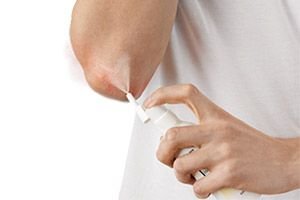
Spray formulations are topical medications applied via sprays or aerosol foams. Their purpose is to deliver the active ingredient to plaques quickly, evenly, and with high tolerability, especially in hairy areas where ointments and thick creams are inconvenient. Spray formulations include super- and high-potency corticosteroids in spray form, as well as fixed combinations of calcipotriol and betamethasone, and nonsteroidal anti-inflammatory foams. This format has been shown to improve convenience and treatment compliance compared to ointments. [1]
Sprays are indicated for the treatment of mild to moderate psoriasis, as well as localized exacerbations in more severe cases. Joint guidelines from the American Academy of Dermatology and the National Psoriasis Foundation support the key role of topical therapy and allow the use of moderate- to high-potency corticosteroids as initial therapy in adults. For scalp lesions, aerosol forms and solutions are preferred due to better penetration and cosmetic acceptability. [2]
The key advantage of spray application is uniform coverage and quick drying without leaving a greasy film. In studies, patients more often choose foams and solutions, while ointments are rated less favorably for convenience and impact on daily activities. This factor is directly related to treatment compliance and outcome. [3]
Nebulization is also relevant for maintenance therapy. A fixed-dose combination of calcipotriol and betamethasone in the form of an aerosol foam has been shown to prolong remission and reduce the number of relapses, compared with a reactive "only during exacerbations" strategy. This was confirmed by a one-year randomized trial. [4]
Evidence base
The superpotent corticosteroid clobetasol propionate 0.05% spray has demonstrated high efficacy in scalp psoriasis. In a randomized, double-blind study, 85% of patients achieved "clear" or "almost clear" skin after 4 weeks, compared to 13% on placebo; the difference was statistically significant. Tolerability was good. [5]
A combination of calcipotriol and betamethasone dipropionate in the form of an aerosol foam is superior to the gel in terms of efficacy and response rate and is well tolerated. According to meta-analyses and randomized trials, this formulation more quickly reduces infiltration and desquamation and improves patient satisfaction. [6]
Desoxymethasone 0.25% topical spray is approved for the treatment of plaque psoriasis in adults. The instructions limit the course duration to 4 weeks and recommend discontinuing use once control is achieved. This medication is a highly potent corticosteroid and requires safety precautions. [7]
A nonsteroidal alternative is roflumilast 0.3% foam. In a randomized trial in patients with scalp and body psoriasis, the drug demonstrated significant improvement and a favorable safety profile, which is important for long-term use and for areas at risk of corticosteroid side effects. [8]
Safety: rules, restrictions and common mistakes
Any nebulized corticosteroid requires strict dosing and limitations on the area of application and duration. For clobetasol 0.05%, the total volume should not exceed 50 ml per week, and the duration should be 4 weeks. Exceeding the dose is associated with the risk of hypothalamic-pituitary-adrenal axis suppression, which is reflected in the labeling. [9]
Propellant-based aerosol formulations are flammable. Manufacturers explicitly instruct against fire, flame, and smoking during and immediately after application. Storage also requires temperature control and protection from heat. This applies to both corticosteroid sprays and the combination of calcipotriol and betamethasone foam. [10]
The fixed combination of calcipotriol and betamethasone can lead to hypercalcemia and hypercalciuria if not administered as directed. If symptoms or laboratory abnormalities occur, the drug should be temporarily discontinued until calcium levels return to normal. [11]
The pediatric use of potent sprays is limited. Some formulations are not recommended for use in individuals under 18 years of age due to the risk of systemic effects. During pregnancy, topical corticosteroids are generally considered relatively safe for short-term use; however, low- and moderate-potency corticosteroids are preferred, while high-potency corticosteroids should be used for the shortest possible course. Topical corticosteroids are acceptable during breastfeeding, but should not be applied to the nipple area. [12]
Choosing a Nebulized Formulation: Guidelines for Clinical Decision Making
For scalp lesions, aerosol foams, solutions, and sprays are preferred due to their better distribution throughout the hair and uniform coverage of plaques. Clobetasol spray and betamethasone foam, as well as a combination of calcipotriol and betamethasone, have been proven effective in this area. [13]
For extensive plaques on the trunk with pronounced scaling, pre-treatment with a keratolytic is helpful to remove excess scale and enhance corticosteroid penetration. Salicylic acid at a concentration of 2%-10% has been proven most effective, with safety caveats for large areas and specific groups. [14]
If long-term support is needed without skin risks, non-steroidal roflumilast foam can be considered for sensitive areas and as a bridge between corticosteroid courses. This approach reduces the frequency of relapses and the total steroid load. [15]
For patients with low compliance and negative experiences with ointment formulations, it is advisable to choose foams and sprays, as they offer a more "friendly" feel and drying time. This choice is supported by patient preference studies and is directly related to actual drug use. [16]
How to properly apply spray products
Before first use, read the instructions for the specific product and assess the affected area. Spray the spray onto the plaque on clean, dry skin from a short distance, then gently rub in until completely absorbed and wash your hands. Avoid applying to the face, groin, and armpits unless specifically directed. [17]
The frequency for corticosteroid sprays in adults is usually twice daily. The course duration is up to 4 weeks, with discontinuation once control is achieved. If there is no improvement after 2 weeks, the diagnosis and treatment plan are reevaluated. Always adhere to the manufacturer's recommended weekly and daily maximum doses. [18]
Aerosol foams are applied once daily to active plaques during the acute phase for 4 weeks, then switched to a proactive regimen of twice a week on previously affected areas, which has been proven to delay relapses. Flammability remains during and immediately after application. [19]
For dense, severely flaking plaques, it is helpful to pre-treat with a salicylic acid-based keratolytic at a safe concentration, especially on the scalp. This increases the effectiveness of the subsequent corticosteroid. Do not use over large areas and avoid in pregnant women. [20]
Table 1. Spray and foam forms: active ingredients, strengths and regulatory restrictions
| Form | Active ingredient | Activity class | Main indications | Course duration | Key limitations |
|---|---|---|---|---|---|
| Spray | Clobetasol propionate 0.05% | Superpotent | Plaque psoriasis in adults, including the scalp | Up to 4 weeks | Do not exceed 50 ml per week, avoid face and folds, flammable |
| Spray | Desoxymethasone 0.25% | High to superpotent | Plaque psoriasis in adults | Up to 4 weeks | Discontinue after monitoring, do not use in case of skin atrophy |
| Spray | Betamethasone dipropionate (approved forms) | High | Plaque psoriasis in adults | According to the instructions | Duration and area restrictions |
| Aerosol foam | Calcipotriol plus betamethasone dipropionate | Combined | Plaque psoriasis in adults, active and maintenance | Daily for 4 weeks, then 2 times a week | Risk of hypercalcemia if recommendations are not followed, flammable |
| Foam | Roflumilast 0.3% | Nonsteroidal phosphodiesterase 4 inhibitor | Psoriasis of the scalp and body in adults | According to the research design | Good tolerance, long-term use is allowed |
Source: instructions and clinical studies. [21]
Table 2. Spray, foam, solution, cream, ointment: what is more convenient for the patient
| Parameter | Spray | Foam | Solution | Cream | Ointment |
|---|---|---|---|---|---|
| Application speed | High | High | Average | Average | Low |
| Comfort in hair | High | High | High | Short | Short |
| Cosmetic acceptability | High | High | Average | Average | Low |
| Impact on commitment | Positive | Positive | Positive | Neutral | Often negative |
Data on patient preferences and their relationship to adherence. [22]
Table 3. Doses and maximums for key spray forms
| Preparation | Frequency | Max weekly dose | Max duration | Special instructions |
|---|---|---|---|---|
| Clobetasol spray 0.05% | 2 times a day | 50 ml | 4 weeks | No more than 26 sprays per application, flammable |
| Desoxymetasone spray 0.25% | 2 times a day | According to the instructions | 4 weeks | Stop under control, do not cover with occlusion |
| Calcipotriol plus betamethasone foam | 1 time per day, then maintenance 2 times per week | According to the instructions | According to the maintenance scheme | Monitoring calcium metabolism if disorders are suspected |
Regulatory sources and instructions. [23]
Table 4. Safety of spray forms: risks and prevention
| Risk | What does it mean | Who cares? | How to reduce |
|---|---|---|---|
| Hypothalamic-pituitary-adrenal axis suppression | Systemic absorption of high-potency steroids | For large areas and long courses | Adhere to weekly limits and duration |
| Atrophy, telangiectasia, hypopigmentation | Local steroid effects | Thin skin, folds | Avoid these areas, switch to less active forms |
| Fire hazard | Propellants and alcohol base | All patients | Keep away from fire and heat sources when applying. |
| Hypercalcemia | The effect of calcipotriol when recommendations are not followed | With prolonged use of large volumes | Follow the regimen strictly and monitor symptoms. |
Safety and labeling sources. [24]
Table 5. Keratolytics as “enhancers” of topical therapy
| Means | Typical concentration | When to use | Important precautions |
|---|---|---|---|
| Salicylic acid | 2%-10% | Dense, highly flaky plaques on the scalp | Do not use on large areas, avoid during pregnancy |
| Urea | 10%-20% | Dryness and moderate flaking | Irritating sensitivity may occur. |
| Lactic acid | 5%-12% | Thickened stratum corneum | Avoid damaged skin |
Keratolytics enhance the penetration of corticosteroids and improve scale removal.[25]
Step-by-step algorithms: exacerbation and maintenance
For scalp flare-ups, daily use of the chosen spray formulation is recommended for 2-4 weeks. If flaking is severe, apply a keratolytic 30-60 minutes before the main application, then rinse and apply the medication. If there is no improvement after 2 weeks, reassess the diagnosis and treatment plan. [26]
Once "clear" or "almost clear" skin is achieved, maintenance therapy is initiated. A proven regimen for a combination of calcipotriol and betamethasone is to apply the treatment twice a week to previously affected areas, with "rescue" courses used in case of relapse. This increases the duration of remission and reduces the number of exacerbations per year. [27]
If long-term control is required in sensitive areas or in occupational risk areas, non-steroidal roflumilast foam is considered on an individualized regimen. This approach allows for a reduction in total steroid exposure without loss of symptom control. [28]
Combinations with emollients are essential at all stages, as basic moisturizing improves the skin barrier and reduces the need for frequent medication applications. The choice of a specific emollient is individual and depends on tolerance. [29]
Frequently asked questions: pregnancy, breastfeeding, children
During pregnancy, topical corticosteroids are considered relatively safe when used in short courses and on a limited area of application. Low and moderate potency formulations are preferred, while high potency formulations are used only under strict indications and for the shortest possible duration. There is evidence linking long-term use of potent formulations with a risk of low birth weight in newborns. [30]
Topical corticosteroids are acceptable during breastfeeding, but they should not be applied to the nipple area. Hands should be washed thoroughly after application to other areas. If long-term monitoring is necessary, the lowest doses and shortest courses are chosen. [31]
Children require special caution due to their higher surface area relative to body mass. For powerful sprays, there are direct prohibitions or restrictions in the instructions, so decisions should only be made in consultation with a dermatologist, considering alternatives. [32]
Aerosol forms are always flammable, regardless of the active ingredient. This applies both at the time of application and for a short period afterward. Failure to properly store and use the product can pose a danger to the patient and others. [33]
Key findings
Spray application is a convenient and proven method of topical therapy, especially for the scalp and other hard-to-reach areas. Clobetasol spray has been shown to be highly effective, while the combination of calcipotriol and betamethasone foam is effective for both remission induction and proactive maintenance, and roflumilast foam provides long-term steroid-free control. Proper choice of formulation and adherence to instructions are critical to efficacy and safety. [34]
Keratolytics help the spray "work deeper," but they are used consciously, in specific regimens, and over a limited area. Any spray formulations containing propellants are flammable and require safety precautions. During pregnancy and childhood, the strategy is always individualized, with priority given to the minimum doses and courses. [35]