

All iLive content is medically reviewed or fact checked to ensure as much factual accuracy as possible.
We have strict sourcing guidelines and only link to reputable media sites, academic research institutions and, whenever possible, medically peer reviewed studies. Note that the numbers in parentheses ([1], [2], etc.) are clickable links to these studies.
If you feel that any of our content is inaccurate, out-of-date, or otherwise questionable, please select it and press Ctrl + Enter.
Turmeric for gout: Does it help, does it affect uric acid, and who needs to be careful?
Medical expert of the article

Last updated: 02.04.2026
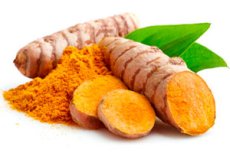
Turmeric for gout doesn't seem like a product that should be automatically banned, but it also can't be considered a proven treatment. The best conclusion to date is that turmeric as a spice is generally acceptable, but concentrated curcumin supplements require much greater caution, as direct clinical evidence of benefit specifically for gout is still limited, and the risks of supplements have already been described. [1]
Current gout guidelines generally do not support the idea of a "special miracle diet" or a single food that will prevent attacks on its own. The UK's National Institute for Health and Care Excellence explicitly states that there is insufficient evidence to support any specific diet for preventing attacks or lowering uric acid levels, and recommends simply following a healthy and balanced diet. [2]
The American College of Rheumatology's guidelines also emphasize not turmeric, but rather truly important factors: limiting alcohol, purines, foods high in high-fructose corn syrup, and weight loss in overweight individuals. This is an important framework for the entire article: if a diet is already overloaded with alcohol, sugary drinks, and excess calories, no spice can compensate. [3]
The most rigorous human test of curcumin in the context of uric acid yielded rather restrained results. In a randomized, placebo-controlled trial in people with asymptomatic hyperuricemia, curcumin showed no superiority over placebo in lowering serum urate or increasing uric acid excretion. This study examined asymptomatic hyperuricemia, not active gout, but it best illustrates why turmeric cannot be considered a proven urate-lowering agent. [4]
Therefore, it's best to view turmeric as a potentially beneficial food ingredient rather than a treatment. While it can be part of a normal diet, when it comes to gout, the key decisions still revolve around uric acid control, attack management, weight, alcohol, and overall metabolic health. [5]
| The main question | Practical conclusion |
|---|---|
| Can you use turmeric for gout? | Usually yes, as a seasoning |
| Is turmeric a proven treatment for gout? | No |
| Does curcumin reduce uric acid in humans convincingly? | Until it is proven |
| Is food safer than supplements? | Usually yes, based on the available data it seems likely |
| What is more important than turmeric itself? | Monitoring uric acid, weight, alcohol and overall diet |
What is known about the potential benefits
Interest in turmeric for gout is primarily due to curcumin, its main biologically active component. Review papers on gout and phytochemicals have described curcumin's ability to influence inflammatory signaling pathways, including nuclear factor-kappa-B and related inflammatory mediators. This is theoretically important for gout, as an attack is triggered not only by high urate levels but also by a highly active inflammatory response to monosodium urate crystals. [6]
In a 2019 preclinical study, curcumin attenuated monosodium urate crystal-induced inflammation in cell and animal models. The authors described reduced paw and ankle swelling, decreased inflammatory cytokines, and effects on the nuclear factor-kappa-B pathway, the NLRB3 inflammasome, and mitochondrial damage. This is a strong biological signal, but it remains preclinical rather than clinically proven for people with gout. [7]
A more recent study from 2025 in a mouse model also looked promising. In it, curcumin reduced ankle swelling, decreased interleukin-1 beta and tumor necrosis factor-alpha levels, reduced serum uric acid, and was associated with suppression of xanthine oxidase activity and increased expression of the urate transporter ABCG2 in the kidneys. But even here, caution is needed: mouse models help to understand the mechanism, not replace human clinical trials. [8]
There is also broader data on arthritis in general. A 2022 systematic review and meta-analysis included 29 randomized trials with 2,396 participants and 5 types of arthritis, including gout and hyperuricemia. Overall, curcumin and turmeric extract were associated with reduced pain and inflammation, but the authors emphasized that the quality of the evidence is low and further randomized trials are needed. [9]
This is precisely why the clinical picture remains mixed. Turmeric has biological plausibility, there are preclinical signals, and the overall arthritis data are moderately encouraging, but there is no evidence yet to support its use in gout as a viable therapy. This balance is crucial for an honest medical text. [10]
| What was studied | What can I say? |
|---|---|
| Cellular and animal models of gout | Curcumin reduced the inflammatory response |
| Mouse model of hyperuricemia and acute gout | Anti-inflammatory and urate-lowering signals are shown |
| A randomized trial in people with asymptomatic hyperuricemia | No convincing superiority over placebo has been demonstrated. |
| Systematic review of arthritis | There are moderate signals for pain and inflammation, but the quality of the data is limited. |
| Result | There is potential, but there is no proven clinical role in gout yet. |
Why turmeric isn't a substitute for basic gout treatment
Gout is a chronic condition in which high urate levels lead to the formation of new crystals, and without intervention, the disease progresses. The National Institute for Health and Care Excellence explicitly recommends explaining to patients that gout is a lifelong condition that can be helped by long-term urate-lowering therapy to remove crystals, reduce tophi, prevent attacks, and prevent joint damage. [11]
Once an attack has already begun, guidelines also rely not on supplements but on medications with proven effectiveness. For first-line treatment of an exacerbation, the National Institute for Health and Care Excellence recommends nonsteroidal anti-inflammatory drugs, colchicine, or a short course of oral glucocorticosteroids, and, if necessary, intra-articular or intramuscular corticosteroid injections. Turmeric is not considered standard therapy in this area of treatment. [12]
For long-term gout control, the goal is even more specific: to lower serum urate below 360 micromol/L, and below 300 micromol/L in cases of tophi, chronic gouty arthritis, or ongoing frequent attacks. The National Institute for Health and Care Excellence recommends allopurinol or fevuxostat as first-line urate-lowering therapy, while the American College of Rheumatology supports a strategy of titrating the dose to the target urate level. Neither of these guidelines recommends turmeric as a substitute for urate-lowering therapy. [13]
Even in the dietary section, the recommendations remain very cautious. The National Institute for Health and Care Excellence states that there is insufficient evidence to support a specific diet, and the American College of Rheumatology emphasizes that the contribution of individual foods and the overall diet to urate levels is usually small compared to a drug strategy. The American College of Rheumatology guidelines explicitly state that the effect of individual foods on serum urate is usually small, and therefore lifestyle advice is provided as a guideline rather than as a substitute for treatment. [14]
Therefore, turmeric's role in gout is purely supportive. It can be considered as part of a balanced diet or as a supplement that someone wants to discuss with a doctor, but not as an alternative to allopurinol, fevuxostat, colchicine, or treatment for an acute attack. This distinction is often lost in popular publications. [15]
| The treatment objective | Can turmeric solve it? |
|---|---|
| Stop an acute attack according to treatment standards | No |
| Lower serum urate to target levels reliably | Not proven |
| Remove monosodium urate crystals from fabrics | No |
| Be part of a healthy diet | Yes |
| Replace urate-lowering therapy | No |
Safety and who needs to be careful
Serious problems with typical dietary amounts of turmeric are rarely reported, and the National Center for Complementary and Integrative Health indicates that conventional oral forms of turmeric or curcumin without bioavailability enhancement technologies are likely safe in recommended doses for up to 2-3 months. However, the same source emphasizes that evidence for turmeric's effectiveness for most conditions is still insufficient. Therefore, even when considering safety and benefits, it's important not to confuse the spice with a high-dose supplement. [16]
The most common gastrointestinal side effects have already been described. The National Center for Complementary and Integrative Health lists nausea, vomiting, heartburn, abdominal discomfort, diarrhea, and constipation as possible side effects of oral turmeric. For someone with gout, this isn't the most concerning aspect, but it's the one that most often occurs in real-life practice when self-medicating with supplements. [17]
The liver issue is far more serious. The National Institute of Diabetes and Digestive and Kidney Diseases' LiverTox database already lists turmeric as a well-documented cause of clinically significant drug-induced liver injury, although such cases are rare. They have been particularly frequently described for forms with enhanced bioavailability, including combinations with black pepper containing piperine, or special lipid and nanoformulations. [18]
Another important risk is stone formation in susceptible individuals. In a randomized, crossover study in healthy volunteers, supplemental doses of turmeric resulted in higher urinary oxalate excretion compared to controls and cinnamon, increasing the risk of stone formation in susceptible individuals. This is particularly relevant for some patients with gout, as urate metabolism and urolithiasis often overlap. [19]
Finally, drug interactions should be considered. The National Centre for Complementary and Integrative Health recommends discussing any herbal supplement with a doctor if a person is already taking medications, as some combinations can be harmful. The Welsh Medicines Information Centre specifically warns of caution when combining turmeric or curcumin with anticoagulants and antiplatelet agents due to a possible increased risk of bleeding. [20]
| Situation | Risk assessment |
|---|---|
| Turmeric as a common spice in food | Generally low risk |
| Concentrated supplements with increased bioavailability | The risk is higher |
| Liver disease or symptoms of liver damage | Special care is needed |
| History of urolithiasis | Caution is needed due to oxalates |
| Taking anticoagulants and antiplatelet agents | A doctor's consultation is required |
How to use turmeric in practice
If the goal is simply to add variety to a diet, turmeric as a culinary spice usually makes sense. It can be used in regular home-cooked meals and doesn't require any special medical certification. Against the backdrop of recommendations to maintain a healthy and balanced diet, this approach seems much more reassuring than buying concentrated capsules promising to "cleanse joints." [21]
Turmeric makes the most sense not as a standalone "treatment," but as part of a dietary pattern that is generally more compatible with gout control. To achieve this, it's more important to reduce alcohol, sugary drinks, and excess fructose, control weight, and build a diet around real, home-cooked meals rather than supplements. Turmeric can be included in this system, but it won't be the main player. [22]
If someone does want to try a curcumin supplement, it's best not to do so during an acute attack or as a replacement for urate-lowering therapy. It's far wiser to discuss the idea with a doctor first, especially if you already have liver disease, a history of kidney stones, or are taking anticoagulants, antiplatelet agents, or multiple medications simultaneously. Such caution is based not on fears, but on the risks already described. [23]
The effect of turmeric also needs to be assessed realistically. If it doesn't change the frequency of attacks, uric acid levels, or the need for anti-inflammatory therapy, then there is no clinical benefit, even if the person believes "a natural remedy should help." This is why current guidelines assess outcome based on attacks, target urate levels, tophi size, and long-term disease control. [24]
The bottom line is simple. Turmeric in food is generally acceptable as part of a healthy diet. Turmeric as a supplement is a less well-supported option with more significant risks, so it requires discussion with a doctor rather than blind faith in its "naturalness." [25]
| Practical step | Why is he intelligent? |
|---|---|
| Use turmeric as a spice, not as a primary treatment. | This means less risk and fewer false expectations. |
| Do not replace standard therapy for gout. | This is contrary to the recommendations |
| Avoid self-prescribing concentrated supplements | More serious risks are described for them. |
| Discuss supplements with your doctor if you have any underlying medical conditions or medications. | Possible interactions and side effects |
| Assess the result by uric acid and attacks, not by sensations | These are clinically significant indicators. |
Answers to frequently asked questions
Is it safe to add turmeric to food if you have gout?
Generally, yes. Culinary quantities of turmeric don't carry the same risk profile as concentrated supplements, and gout recommendations generally allow for a healthy and balanced diet without resorting to a single, forbidden spice or food. [26]
Does turmeric reduce uric acid in people with gout?
There is no convincing clinical evidence yet. In a randomized, placebo-controlled trial in people with asymptomatic hyperuricemia, curcumin was not superior to placebo in reducing serum urate. [27]
Does turmeric help with pain during an attack?
There is biological plausibility, as curcumin affects inflammatory pathways, and arthritis studies have generally noted a reduction in pain and inflammation. However, for an acute gout attack, first-line medications, not turmeric, remain the standard. [28]
Can turmeric replace allopurinol or fevuxostat?
No. These medications are used to achieve target uric acid levels and remove crystals, and turmeric has no proven role in this regard. [29]
Are curcumin supplements safe?
Not always. Regular forms in recommended amounts appear relatively safe in the short term, but cases of drug-induced liver injury have been reported with supplements with enhanced bioavailability. [30]
Who should especially avoid experimenting with curcumin without a doctor's advice?
People with liver disease, a history of kidney stones, and those taking anticoagulants, antiplatelet agents, or multiple medications simultaneously. The most practical risks and reasons for caution are described for these groups. [31]
Is it true that turmeric is completely natural and therefore safe?
No. Being natural doesn't negate the potential for side effects, interactions, and rare but serious complications, including liver damage. [32]
Is there any point in taking turmeric if gout is already well controlled?
As a spice, yes, it's an acceptable part of the diet. As a supplement, the question remains open, because there's no proven need, and the risks for some people are already known. [33]
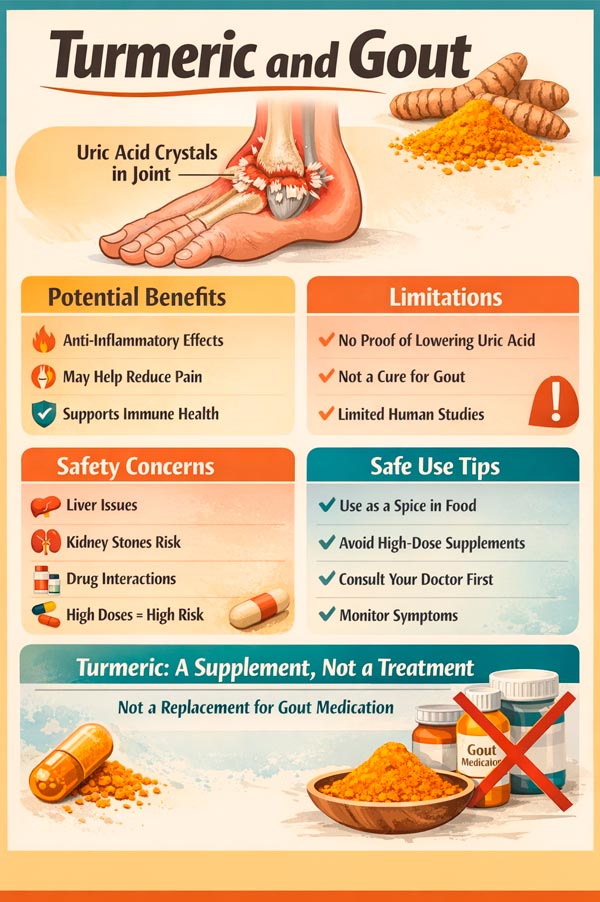
Key points from experts
Nicola Dalbeth is a professor and academic rheumatologist at the University of Auckland, and director of the Gout Clinical and Laboratory Research Program.
Her profile clearly indicates that her primary research topic is gout. From a practical perspective, this supports the article's main conclusion: the prognosis for the disease is not altered by a single supplement, but by long-term uric acid control and consistent patient management. [34]
Hyun Choi is a leading clinical rheumatologist and researcher at Massachusetts General Hospital, with a primary academic focus on gout and other inflammatory arthritis.
His line of research is particularly important for nutritional topics because it helps us look beyond a single "healthy" food to the entire metabolic and dietary pattern. For turmeric, this means a simple thing: the spice doesn't negate the role of weight, alcohol, sugary drinks, and target urate levels. [35]
Edward Roddy is Professor of Rheumatology at Keele University, an Honorary Consultant Rheumatologist, and one of the UK's leading experts on gout.
His professional background aligns well with the British practice approach: a healthy, balanced diet is beneficial, but should not replace proven therapy. In the context of turmeric, this means a moderate stance, free from demonization and marketing exaggeration. [36]
Conclusion
Turmeric is often used as a spice for gout, but it has not been proven to be a fully functional treatment. Biological and preclinical data are promising, but a convincing urate-lowering effect has not yet been demonstrated in humans, and concentrated supplements are already associated with liver risks, possible interactions, and increased oxalate load in susceptible individuals. [37]
So the most honest formula is this: turmeric in food is usually acceptable, turmeric in capsules is controversial and requires caution, and gout control remains based on achieving target uric acid levels, treating attacks as recommended, and addressing real risk factors. [38]